
The fashion trends of the season are no longer just a checklist of items to tick off. We are witnessing a profound reconfiguration of how a wardrobe is built, between targeted new pieces, resale circuits, and European regulatory constraints that modify the available offerings in stores. Understanding these mechanisms allows for more precise purchasing decisions than any lookbook.
Digital textile passport and ban on unsold goods: what is changing in stores
The European Union will prohibit major brands, starting July 2026, from landfilling or incinerating their unsold textiles. The obligation to prioritize resale, donation, or recycling has a direct impact on the collections offered on the shelves: brands are reducing the depth of their ranges to limit excess inventory.
At the same time, the digital textile passport is gradually coming into effect. Each garment will need to carry complete traceability of its production chain. For consumers, this means access to the exact composition of fibers, manufacturing locations, and associated working conditions.
This regulatory shift is pushing brands to concentrate their seasonal collections on fewer references, with adjusted volumes. Trendy pieces for the autumn season are therefore becoming rarer towards the end of the cycle, which alters the timing of purchases. We recommend acquiring coveted pieces at the beginning of the season rather than waiting for sales, where restocking will be limited.
To follow fashion trends on Hermaphrodite, this logic of programmed scarcity serves as a useful filter before any seasonal purchase.
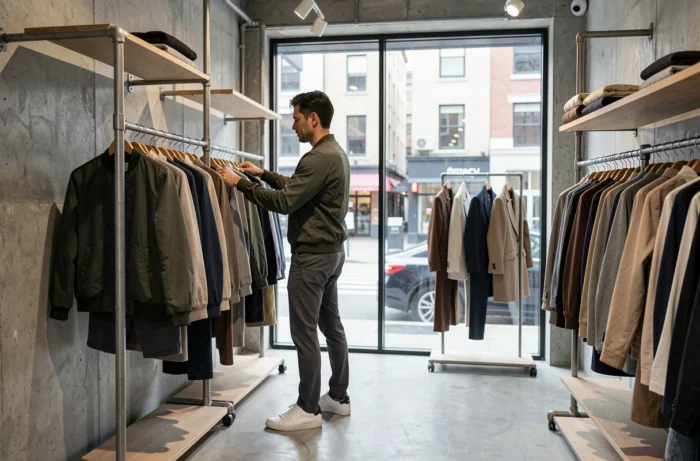
Leather, red, and oversized: technical analysis of the three strong axes for autumn 2026
The spring-summer and autumn-winter 2026 fashion shows converge on three stylistic directions. Their common point: they work equally well as a standout piece or as the foundation of a complete wardrobe.
Saturated red as the guiding color
After several seasons dominated by neutral tones, red is making a strong comeback. This is not a discreet burgundy but a vivid red worn as a statement piece: structured jacket, midi dress, or tailored trousers. The technical interest of this color lies in its ability to enhance any neutral base without requiring complex accessorization.
One red element is enough to anchor a silhouette. Multiplying pieces in this shade produces the opposite effect and shifts the look into costume territory.
Leather as a structuring material
The leather jacket remains a safe bet, but the novelty lies in the extension of leather (and its plant-based alternatives) to unusual pieces: midi skirts, wide trousers, sleeveless vests. Leather is no longer confined to the upper body, opening up new combinations with fluid materials like knitwear or linen.
Recalibrated oversized
Loose cuts persist, but with a noticeable adjustment. Volumes are now concentrated on the top (jacket, blazer, sweater) while the bottom tightens slightly. This contrast in proportions avoids the “drowned in clothing” effect that characterized the early iterations of the oversized trend. A straight trouser or semi-slim jean balances an oversized blazer much better than an XXL cargo pant.
Building a seasonal style with second-hand: re-commerce as a strategic lever
The global resale market reached $289 billion in 2025 and is growing about twice as fast as the traditional clothing market. In France, fashion accounts for about 40% of the second-hand market, with an annual growth rate close to 20%.
These figures do not reflect a marginal phenomenon. They indicate a methodological shift: asserting one’s style now involves a mix of targeted new items and selective second-hand. Buying a vintage leather jacket from the 1990s is often cheaper than a new entry-level model, with often superior material quality.
Re-commerce also changes the notion of seasonal trends. An oversized piece spotted on the autumn 2026 runways may already exist in the resale circuit, stemming from a previous collection with a similar design. Knowing how to identify these equivalents is a real advantage for building a trendy wardrobe without renewing the entirety of one’s closet.
Three criteria help decide between new and second-hand purchases for each seasonal piece:
- Does the piece belong to a micro-trend (lifespan of one to two seasons) or an updated basic? Micro-trends are better suited to second-hand, as the risk of fatigue is higher.
- Does the material support previous use? Leather, denim, and wool age well. Lightweight synthetic fibers (fine polyester, low-quality viscose) lose their shape after a few washes.
- Does the estimated resale value justify a new purchase? A garment from a brand with a stable market value in the secondary market is a better investment than a discounted purchase from a brand without a resale market.

Women’s pieces and men’s wardrobe: the cross borrowings that define the season
The men’s wardrobe has structurally fueled women’s trends for several seasons. Autumn 2026 confirms this dynamic with two significant transfers: derbies, which are gradually dethroning sneakers as the default shoe, and the small check shirt, popularized by collaborations between designers and accessible brands.
Derbies provide a visual structure to the foot that sneakers do not produce. Paired with slightly cropped trousers or a midi dress, they anchor the silhouette downwards and create a sought-after contrast of registers (formal/casual) this season.
The baseball t-shirt, another borrowing from the men’s wardrobe, serves as a transitional piece between seasons. Its raglan cut and thick jersey fabric make it compatible with an oversized blazer without creating a material overload at the shoulders.
These cross borrowings are not a passing fashion effect. They reflect a deeper trend towards less gendered wardrobes, where cut and material take precedence over traditional categorization of departments. For the back-to-school season, investing in one or two well-chosen masculine-inspired pieces offers more versatility than a classic exclusively feminine wardrobe.