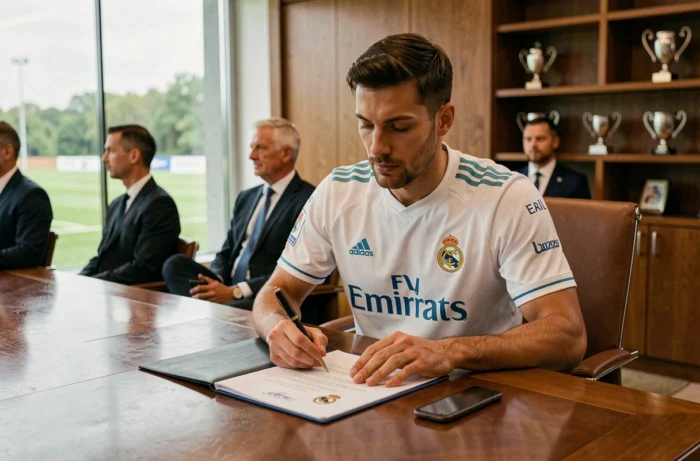
Real Madrid allocates a significant portion of its budget to player salaries each season. For the 2026-2027 season, the annual wage bill for the squad is around 274 million euros, driven by contracts signed with several of the highest-paid footballers in the world. Understanding the structure of these remunerations requires distinguishing three levels: the salary cap set by LaLiga, individual gross salaries, and contract durations that determine the stability of the group.
LaLiga Salary Cap and Real Madrid’s Financial Margin
LaLiga imposes a salary cost limit on each club, recalculated annually based on the club’s accounts. This cap includes salaries, social charges, and amortizations related to transfers. It does not represent a budget spent, but a maximum allowable amount.
For the 2026-2027 season, LaLiga has set this cap at approximately 832.8 million euros for Real Madrid, a record in La Liga. This figure is explained by very healthy accounts and a mechanism unique to the Spanish league: clubs can reinject up to 25% of savings accumulated in previous years, upon validation by LaLiga’s financial authorities.
A detailed consultation of salaries and contracts of Real Madrid players 2026 allows us to measure the gap between the actual wage bill and this cap. The club maintains a substantial margin of maneuver, enabling it to absorb high contracts while remaining compliant with competition rules.

Weekly Salary of Real Madrid Players: Disparities Within the Squad
The salary grid of Real Madrid in 2026-2027 shows significant disparities between the stars and the rest of the squad. The average weekly salary of players aged 22 and over is around 228,000 euros.
Three players account for the largest share of the wage bill:
- Kylian Mbappé earns about 581,490 euros per week, which amounts to over 30 million euros annually. His contract runs until June 2029, making it the club’s heaviest commitment over time.
- Vinícius Júnior, after his extension signed in August 2026, earns about 403,650 euros weekly. His new six-year contract secures his long-term presence and places his annual salary around 21 million euros.
- Jude Bellingham is at the same salary level as Vinícius, with a long-term contract signed upon his arrival.
At the other end of the spectrum, a backup goalkeeper like Andriy Lunin earns about 75,184 euros per week, and the young players recently integrated into the professional group are still below that. The salary of the highest-paid player is nearly eight times that of a substitute.
Distribution by Position
The distribution of the weekly wage bill of 5.3 million euros reveals a net imbalance. Forwards capture 47% of the total, defenders 35%, midfielders 11%, and goalkeepers 7%. This ratio reflects the club’s sports policy, which invests heavily in its offensive players.
Contracts and Deadlines: Managing Contract Expirations
Beyond the gross amount, the duration of contracts determines a player’s accounting value and the club’s negotiating power in case of transfer. A long contract protects the investment; a contract nearing its end exposes the club to a free departure.
The case of Vinícius Júnior illustrates this logic. Before his extension in August 2026, his contract was set to expire in June 2027. Real Madrid preferred to renegotiate upwards rather than risk a free departure. Vinícius’s extension guarantees the club six additional years of stability on its left wing.
Mbappé, under contract until 2029, will not raise contract questions for several seasons. Thibaut Courtois, who arrived in 2018, is among the players whose contractual situation deserves particular attention given his age and injury history.

Real Madrid’s Wage Bill Compared to Other La Liga Clubs
The salary cap granted to Real Madrid (832.8 million euros) significantly exceeds that of FC Barcelona, set at 582.8 million euros for the same season. This gap of 250 million reflects very different accounting situations between the two rivals.
This financial lead does not mean that Real spends more on net salaries. It indicates that the club has a higher regulatory capacity to recruit, extend, or adjust its wage grid without breaching LaLiga’s rules. In practical terms, Real can offer competitive contracts against clubs like Al-Hilal or major Premier League clubs without jeopardizing its financial balance.
The high cap for 2025-2026 was already around 761.2 million euros. The progression to 832.8 million confirms that the club’s revenues (ticket sales from the renovated Santiago Bernabéu, broadcasting rights, sponsorship) continue to grow faster than its expenses.
Boni and Additional Compensation at Real Madrid
Fixed salaries represent only a part of the total compensation. Real Madrid players receive bonuses related to sporting results: qualification for the Champions League knockout stage, titles won, individual objectives. These bonuses, variable according to the player’s status and negotiated clauses, can represent a significant supplement.
The remuneration structure also includes image rights, the sharing of which between the player and the club is subject to specific negotiations at each signing. For a player like Mbappé, whose commercial value far exceeds the sporting framework, these rights constitute a full-fledged negotiating lever.
The salary policy of Real Madrid in 2026 is based on a clear principle: concentrate the highest amounts on a small core of offensive players while maintaining a regulatory cap sufficiently high to absorb these commitments. The extension of Vinícius and the duration of Mbappé’s contract set the club’s salary structure for the coming seasons, leaving little room for additional massive recruitment at this salary level.