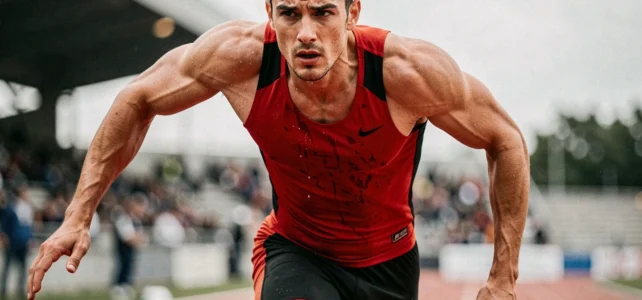
The maximum speed of a sprinter does not primarily depend on the force applied to the ground. Recent biomechanical research has shifted the focus: it is the angular velocity of hip flexion and the control of the swing phase of the lower limb that determine the achievable speed ceiling. This paradigm shift requires a rethinking of sprint training and projections on future records.
Swing phase and hip speed: the true limiting factor of sprinting
For decades, sprint biomechanics focused on the support phase, the fraction of a second when the foot pushes against the ground. The idea seemed logical: the greater the ground force, the more the impulse propels the sprinter. Recent models invalidate this simplistic view.
The swing phase, when the free limb moves forward, imposes a mechanical bottleneck. The speed at which the femur rotates around the hip joint dictates the maximum stride frequency.
A sprinter who generates colossal force on the ground but whose hip “rotates” slowly will not be able to increase their step frequency beyond a threshold. This is a neuromuscular constraint, not simply muscular: the central nervous system must coordinate the contraction of the hip flexors and adductors within a time window of a few hundredths of a second.
To understand how far human speed can go, one must look at joint mechanics as much as raw muscle power. The hip flexors and the muscles on the inner thigh become priority training targets, where tradition favored the hamstrings and quadriceps.

Asymptotic limit of the 100 m: why the record plateaus around 9.4-9.5 seconds
Analyses of the evolution of 100 m records, incorporating all data from the 20th century and Usain Bolt’s performances, converge towards a clear prediction. The men’s 100 m record stabilizes around 9.48 seconds, according to updated regression models. The progression curve draws an asymptote: future gains will be marginal, on the order of a hundredth of a second, and not spectacular.
This plateau is explained by the overlap of several physiological constraints:
- The speed of nerve conduction, which limits reaction time and the frequency of motor unit recruitment, cannot be increased through training beyond a certain genetic threshold.
- The stiffness of the Achilles tendon and the plantar fascia, which stores and releases elastic energy with each stride, reaches a structural maximum related to collagen composition.
- The ratio between ground contact time and flight time cannot be compressed indefinitely without degrading running mechanics (loss of trunk verticality, excessive center of mass oscillation).
Bolt’s record of 9.58 seconds is already about a tenth of this theoretical barrier. Each hundredth gained will require adapted running conditions (wind, temperature, track, altitude) combined with an exceptional genetic profile.
Biomechanical simulations and theoretical sprinter
Recent simulations have modeled an “ideal” sprinter combining the best parameters measured in different athletes: stride length, frequency, ground force, hip rotation speed. This theoretical sprinter could run significantly faster than the current record, but no real individual simultaneously meets all these adapted parameters. The limit is not that of a single parameter; it is the statistical impossibility of combining all maxima in a single organism.
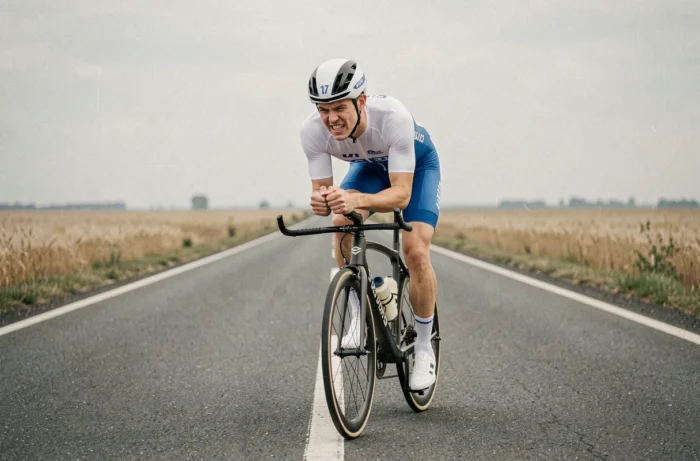
Endurance and ultra-distance: a different physiological logic
Sprinting and endurance do not share the same limiting factors. In ultra-distance, the dominant constraint is no longer neuromuscular but metabolic and thermoregulatory. The marathon remains a giant problem of physiology, not just willpower.
VO2max (maximum oxygen consumption) sets the aerobic ceiling. The highest values measured in elite athletes in cycling or cross-country skiing approach what some researchers consider the human limit. Beyond a certain threshold, cardiac output can no longer increase because stroke volume and maximum heart rate are constrained by the size of the left ventricle and the stiffness of the pericardium.
In running, the modulation of the stride length/stride frequency ratio according to speed has measurable biomechanical and energetic consequences. Lengthening the stride beyond the optimal point increases the energy cost per meter traveled, which accelerates the depletion of glycogen reserves. Running economy becomes the discriminating parameter between two runners with comparable VO2max.
Thermoregulation and central fatigue
Beyond two hours of intense effort, core body temperature gradually rises. The brain then reduces muscle recruitment to protect the body, a mechanism called central fatigue. This “central governor” acts before the muscles themselves are physiologically unable to contract. Performance in ultra-trail or marathon thus depends as much on the ability to dissipate heat as on the available muscle power.
Records of human speed and trajectory of future gains
The men’s 100 m has gained about four-tenths of a second over a century. The men’s marathon has lost several minutes over the same period. But the progression curve is slowing in both disciplines. Records are falling less frequently, and the margins for improvement are shrinking each decade.
Several levers remain accessible: optimization of running surfaces, carbon-plated shoes (whose effect on energy cost is documented), natural genetic selection in populations with high sports participation, and improvement of nutritional protocols in races. None of these levers promise a qualitative leap comparable to that observed between the 1960s and 2000s.
Maximum human speed approaches a measurable physiological ceiling, which sports sciences now allow to quantify precisely. The coming decades will likely see records fall by a hundredth of a second, in increasingly rare ideal condition windows. The human body is not done surprising, but the margin is now measured in tiny fractions.