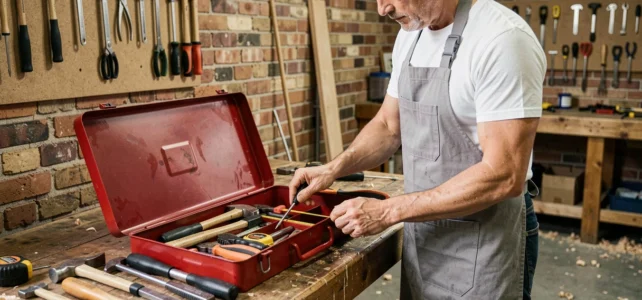
Installing a shelf, replacing a faucet seal, fixing a frame in drywall: these small everyday tasks do not require a professional workshop. They require a handful of well-chosen tools, stored in an accessible box. The classic trap for beginners is to buy too much or too little. A few versatile and good-quality tools cover the vast majority of regular maintenance needs.
Counterfeiting and CE marking: what a cheap tool is really worth
Before even talking about a hammer or a drill, one reflex deserves to be acquired: check the CE marking on each tool purchased. This marking certifies that the product meets European safety requirements. On a drill, it guarantees, for example, electrical insulation and protection against overheating.
The problem is counterfeiting. Tools sold online at very low prices sometimes display a fake CE logo. A counterfeit CE marking protects neither the user nor the installation. To spot a counterfeit, compare the typography of the logo with that of the official marking: the letters C and E must have a precise and standardized spacing. An abnormally low price compared to the market is also a warning signal.
You will find a complete overview of equipment on the Ben Le Bricoleur website, which details reliability criteria by tool category. Favor physical stores or specialized marketplaces that take responsibility for product compliance.
Hand tools for regular maintenance: the real foundation of a toolbox
Individuals are now directing their work towards regular maintenance and necessary repairs rather than large renovation projects. The toolbox should reflect this reality. There’s no need to store specialized equipment that will be used once a year.
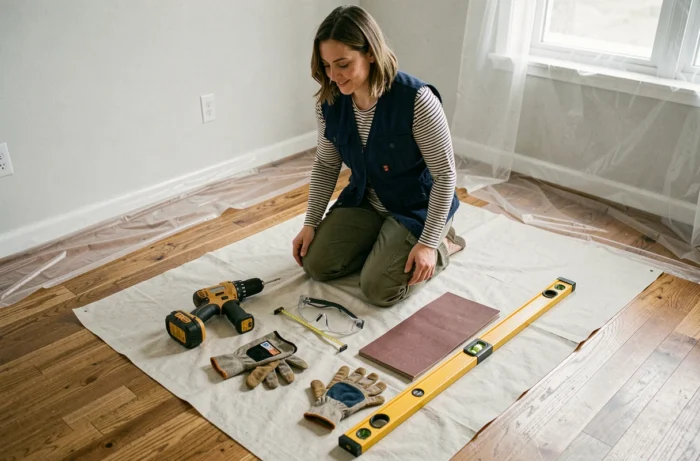
Here is the concrete foundation of a beginner’s toolbox:
- A carpenter’s hammer (not too heavy, around 300 g) for driving nails and adjusting pieces. A model with a fiberglass handle absorbs vibrations better than a raw wood handle.
- A set of flat and Phillips screwdrivers, preferably with magnetic tips. Two sizes of each are sufficient to cover the common screws for furniture, outlets, and switches.
- An adjustable slip joint pliers, useful for tightening, holding, or unscrewing a stubborn nut under a sink.
- A five-meter tape measure and a compact spirit level. Measuring and checking plumb before drilling avoids most mistakes.
- A retractable blade utility knife and an adjustable wrench for simple plumbing connections.
This kit fits into a medium-sized plastic box. It covers furniture assembly, minor plumbing, wall fixings, and basic electrical repairs (like replacing a switch, for example).
Why avoid low-cost “all-in-one” tool sets
Toolboxes sold with several dozen pieces for a low price seem attractive. In practice, the quality of each individual tool is often sacrificed. A screwdriver whose tip rounds off after a few screws damages screw heads and makes work tedious.
It’s better to buy each tool separately, choosing recognized brands from specialized retailers. The initial extra cost is offset by a significantly longer lifespan.
Cordless drill-driver: the first power tool to buy
If only one power tool could join the toolbox, it would be the cordless drill-driver. It screws, unscrews, drills wood, thin metal, and drywall. With a good set of bits and tips, it replaces several hand tools and cuts the work time in half or even a third when assembling furniture.
Choose a model with variable speed and adjustable torque. The variable speed allows for a gentle start in fragile materials. The adjustable torque prevents the screw from being buried in the wood or cracking the drywall.
The battery voltage (expressed in volts) gives an idea of the power. For home DIY, a mid-range drill-driver is more than sufficient. High-end professional models are oversized for hanging a curtain rod.
Battery: a often overlooked criterion
Have you ever noticed that a nearly empty battery drill loses all its power? Lithium-ion technology has solved this problem: it maintains a constant torque until the end of the charge. Also, check that the charger is included and that the brand offers batteries compatible with other tools in the same range. An interchangeable battery system limits future expenses when you add a jigsaw or sander.
Rent rather than buy: the cost-effective reflex for specialized tools
A floor sander, a rotary hammer, a router: these tools are expensive and are only used a few times in an amateur DIYer’s life. Daily rentals, offered by most DIY stores, cost a fraction of the purchase price.
The rule is simple. If a tool is used less than two to three times a year, renting is almost always more advantageous. This reasoning also applies to bulky equipment like rolling scaffolding or pressure washers.
The second-hand and reuse market offers another avenue. Specialized platforms allow you to buy brand-name tools at reduced prices, provided you check the general condition and the presence of the CE marking.
Personal protective equipment: the item beginners forget
Drilling concrete sends shards flying. Sanding wood releases fine dust. Handling treatment products exposes the skin and respiratory tract. Safety glasses, suitable gloves, and a dust mask are not optional.
- Wrap-around safety glasses (EN 166 standard) for drilling, cutting, and sanding.
- Fitted work gloves, not too thick, to maintain dexterity while protecting the hands.
- FFP2 dust mask for prolonged sanding or working in a confined space.
- Earplugs for using noisy tools like the circular saw or rotary hammer.
These items represent a modest budget compared to that of the tools, and they fit in the box without taking up space.
One last practical point: store your tools clean and dry after each use. A rusty utility knife blade cuts poorly, and a dirty drill chuck jams. Minimal maintenance of your tools is what transforms a one-time purchase into a lasting investment.