
Choosing a pilot school before attempting the Cadets Air France competition is not just about comparing prices on a chart. It’s about deciding in which environment you will build your aeronautical foundations, your work reflexes, and your resilience to the selection tests. The Cadets program fully funds the training of selected candidates, but you must arrive at the selection with the right skill set.
Enhanced Qualiopi Certification: the first filter for a reliable pilot school
Before looking at the fleet of aircraft or the promised number of flight hours, ask yourself a more down-to-earth question: does the school display the Qualiopi certification? This label is mandatory for a training organization to have its courses funded by public or pooled funds (CPF, OPCO, France Travail).
Since the summer of 2026, a decree (decree no. 2026-728) has tightened the national quality reference. Starting from November 1, 2026, Qualiopi audits will require more transparency regarding pedagogical methods, actual outcomes, and traceability of distance training. Schools must display verifiable and non-deceptive results.
In practical terms, a school that had Qualiopi in 2024 might not retain it after the new audits. If you compare two institutions, ask for the date of the last audit and inquire about their compliance with the updated reference. A school that cannot clearly answer this question deserves your distrust.
To delve deeper into the selection criteria for a school suited to your profile, it is helpful to choose your pilot school for the Air France competition considering these recent regulatory developments.
Preparation for psychological and cognitive tests: what the school must really offer
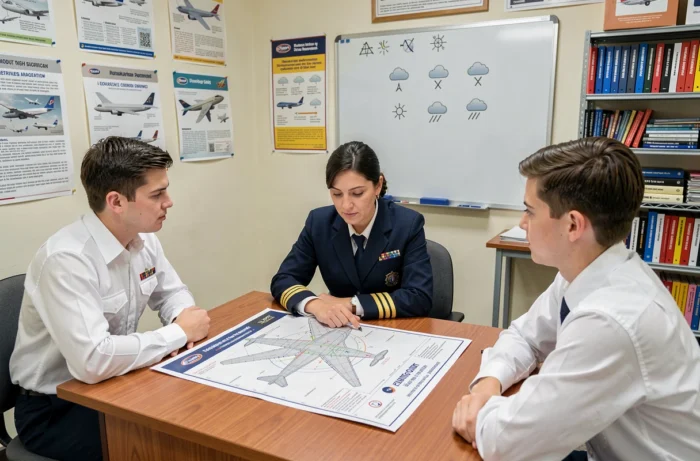
The Cadets Air France competition does not start with a flight. It begins with a series of psychotechnical and cognitive tests that eliminate the majority of candidates before they even touch a control stick. Your school must prepare you for this reality.
What the pre-selection tests really assess
The psychological tests evaluate the ability to process multiple pieces of information simultaneously, time stress management, and the ability to reason under pressure. These are not general knowledge multiple-choice questions. A brilliant candidate in aeronautical theory may fail the cognitive tests if they have never faced them in realistic conditions.
Some schools integrate preparation modules for the psychological tests into their curriculum. Others simply provide a list of online resources. The difference is significant in terms of results.
Concrete criteria to verify
When visiting a school or speaking with its teaching team, ask specific questions:
- Does the school offer timed training sessions for the psychotechnical tests, with individualized feedback on your weaknesses?
- Does it have cognitive test simulators replicating the conditions of the Cadets selection (multitasking, coordination, working memory)?
- What percentage of its former students passed the psychological tests in recent campaigns, and is this figure verifiable?
A school that cannot document its students’ results in the selections gives you no guarantee regarding the relevance of its preparation.
Integrated or modular training: what path before the Cadets competition
In France, two main training formats coexist for future pilots: the integrated path and the modular path. The choice between the two has a direct impact on your preparation for the Air France competition.
The integrated path concentrates all modules (ATPL theory, flight, simulator) over a continuous period, often between 18 and 24 months. The modular path, on the other hand, allows you to validate each component separately, at your own pace, possibly combining several schools.
The Cadets Air France program finances the entire training of selected candidates. This means you do not need to arrive with a professional pilot license in hand. However, having a PPL (private pilot license) and a few dozen flight hours is a concrete advantage during the selection.
If your budget is limited, the modular path offers more flexibility. You can obtain your PPL at a flying club at a much lower cost than an integrated school, and then dedicate your remaining resources to specific preparation for the selection tests.
ENAC, private schools, and flying clubs: comparing training environments
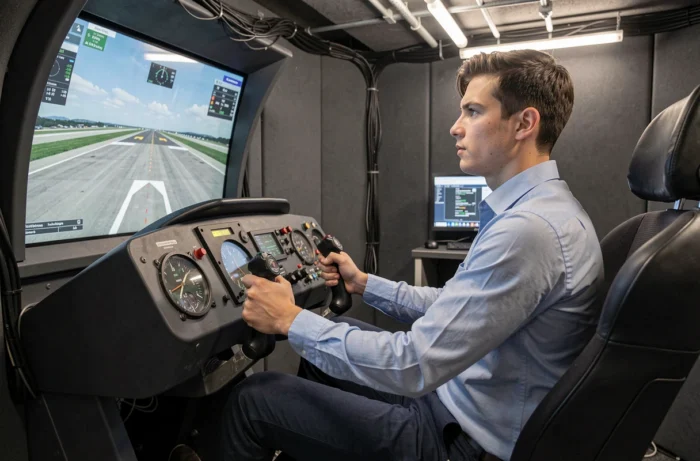
ENAC remains the public reference for airline pilot training in France, but its EPL competition is extremely selective. Private schools offer comprehensive courses, sometimes with direct partnerships with airlines. Flying clubs provide access to flying at a lower cost, but without a dedicated preparation structure for the competitions.
What matters for the Cadets competition is not the prestige of the name on your CV. It is the quality of the preparation for the specific selection tests of Air France.
Here are some benchmarks for comparison:
- Check if the school has instructors who have themselves passed or prepared candidates for the Cadets or ENAC EPL selections.
- Look at the diversity of the fleet: a candidate who has flown several types of aircraft shows adaptability appreciated in selection.
- Evaluate the rigor of the educational follow-up: personalized support is better than a standard program identical for all profiles.
- Inquire about the existence of an active alumni network in commercial aviation that can provide concrete guidance.
A local flying club may suffice for the PPL if you complement it with specialized test preparation. A private integrated school is justified if it offers a real preparation program for the selection, not just flight hours.
The Cadets Air France competition attracts a large number of candidates each year for a limited number of places. The difference rarely lies in raw talent. It lies in the relevance of the preparation beforehand, and therefore in the choice of the school that structures this preparation. Start by checking the certification, inquire about the actual results in the selections, and do not let a marketing brochure replace an on-site visit and an honest exchange with the instructors.