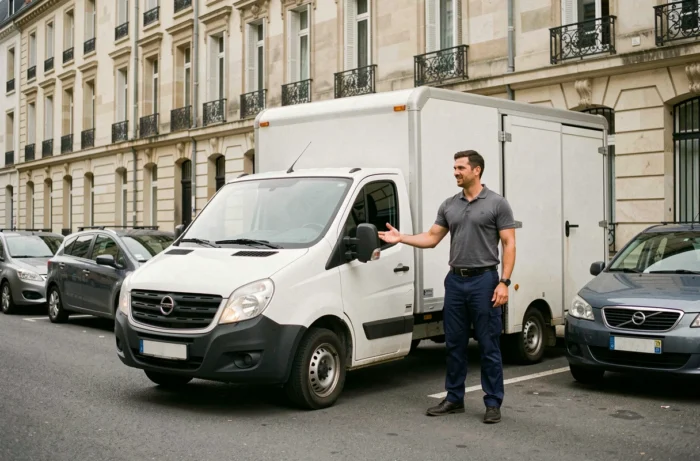
We load a two-seater sofa, three boxes of dishes, and a bicycle, and the rear door refuses to close. The problem does not come from the announced volume, but from the shape of the loading area and the height available under the roof. Choosing a 6m3 vehicle suitable for what you are actually transporting requires looking beyond the gross figure displayed on the technical sheet.
GVW and B license: the constraint that takes precedence over volume
Before comparing floor lengths, we check a regulatory point. A thermal utility vehicle can still be driven with a B license as long as its GVW does not exceed 3.5 tons. For a 100% electric utility vehicle, France allows driving with a B license up to 4.25 tons under certain conditions.
This distinction changes the game. Two vans each showing 6m3 of useful volume can have very different payloads. An electric model, heavier when empty due to the batteries, sometimes leaves less room for loading than a diesel of the same size.
We start by mentally weighing what we are transporting. A studio move with boxes of books weighs much more than a load of lightweight flat-pack furniture. The available volume is useless if we reach the weight limit before filling the space. By understanding the dimensions of a 6m3 truck and its payload, we avoid finding ourselves overloaded on the road.

Floor length and usable height: the dimensions that really matter
The figure 6m3 encompasses very different configurations. Some models offer a long but low floor, while others provide a more cubic space. For transporting furniture, the interior height determines whether a wardrobe can stand upright or must travel lying down, which consumes much more floor space.
Compact van or extended van
Compact vans like the Renault Kangoo, Citroën Berlingo, or Peugeot Partner offer a volume close to 6m3 in a short size. Their advantage: urban maneuverability comparable to a sedan. You can park in a standard space and pass tolls in class 1.
Extended vans (long versions of the Renault Trafic, Peugeot Expert, or Mercedes Vito) also reach 6m3, but with a deeper floor. They are better suited for transporting panels, boards, or any bulky items in length.
Criteria to measure yourself
- The width between wheel arches: it often reduces the usable width on the floor by several centimeters compared to the advertised width
- The loading threshold height: a low threshold makes it easier to handle heavy loads like a washing machine or refrigerator
- The presence of a sliding side door: essential if loading in the city along a sidewalk, without being able to fully open the rear doors
- The actual length of the floor, measured on the ground and not diagonally as some commercial sheets do
Low Emission Zones and engine type: a choice that conditions access to city centers
In 2025, Paris and Lyon applied restrictions to Crit’Air 3 vehicles. The schedules vary from one metropolis to another, and there is no uniform national ban on diesel. Feedback on this point varies according to municipalities, but the trend remains toward gradual tightening.
For regular use in urban areas, a 6m3 utility vehicle classified as Crit’Air 1 or electric avoids unpleasant surprises. For occasional use in rural or suburban areas, a recent diesel remains functional in most territories.
Electric: the compromises to know
Electric utility vehicles of 6m3 are multiplying in the European market, with sales on the rise. The Fiat E-Scudo, Peugeot E-Expert, or Citroën ë-Jumpy offer loading volumes comparable to their thermal equivalents.
The compromise concerns two points. The weight of the batteries reduces the available payload. And the range, when loaded on the highway, decreases significantly compared to the advertised figures. A journey of over 200 km loaded requires careful planning of recharges.

Adapting the 6m3 vehicle to three concrete use cases
Rather than listing all possible uses, we focus on three situations where the choice of model makes a real difference.
Moving a studio
A single bed, a desk, a dresser, and about ten boxes fit in a compact 6m3. The priority: check that the interior height allows the mattress to stand upright to free up the floor space. A long version of the Citroën Berlingo is suitable. A standard Kangoo will be too short for a full bed frame.
Transporting appliances
A washing machine weighs between 60 and 80 kg depending on the models. We prefer a vehicle with a low loading threshold and a non-slip floor. The payload matters more than the volume: we check that there is still room after accounting for the weight of the appliance, the dolly, and the protective packaging.
Recurring professional use
A tradesperson who transports equipment every day needs interior fittings (shelves, tie-down points). Some models like the Volkswagen Caddy Cargo offer built-in fitting options. The daily ergonomics of loading weigh as much as the gross volume on actual productivity.
The right 6m3 is not the one that shows the largest useful volume figure. It is the one whose interior shape, payload, and engine type match what you put in it, how often you use it, and the areas where you drive. Measuring before booking remains the only reliable way to avoid an unnecessary round trip.