The turban is not just a simple hair accessory. It is a textile piece in its own right, with its material constraints, tying codes, and, recently, a European regulatory framework that modifies its production. Understanding these parameters allows for the selection of a turban that lasts over time and integrates into a personal style without a costume effect.
European textile regulation and its impact on turbans
Since the entry into force of the European regulation ESPR (EU 2024/1781) in July 2024, all textiles placed on the EU market are gradually subject to eco-design requirements. Turbans and hair scarves are no exception: durability, recyclability, and limitation of problematic substances are becoming mandatory criteria.
Another notable change: since July 19, 2026, large fashion companies can no longer destroy their unsold textiles, including turbans. They must prioritize sale, donation, or preparation for reuse. This obligation will be extended to medium-sized companies in 2030.
The ESPR also provides for a digital product passport for textile articles. This system will allow for tracing the composition, origin, and manufacturing conditions of a turban. For the consumer, this means direct access to sustainability information before purchase, which did not exist before.
These regulatory constraints are pushing brands to rethink their materials and processes. A turban sold in France in 2026 is no longer manufactured according to the same standards as it was three years ago. This is a factor to consider in any purchasing decision, well before color or pattern.
Silk, cotton, or viscose turban: which material for which use
The choice of material determines both comfort, the hold of the tying, and the longevity of the turban. Three fabrics dominate the market, each with distinct characteristics.
Natural silk remains the reference for elegant turbans worn on formal occasions. It glides over the hair without creating friction, which limits hair breakage. However, it wrinkles quickly and does not withstand repeated washing well.
Cotton, more accessible, is suitable for everyday use. Its slightly rough texture ensures a good grip on the head, making tying easier even without pins. It absorbs sweat, an advantage for hot days. Its limitation: it lacks fluidity for sophisticated draping.
Viscose and synthetic satin offer a compromise between shine and durability. Their maintenance is simple, and they come in a wide range of colors and prints. The collections available on madame-turban.fr illustrate this diversity of materials and styles suited to different occasions.
- For an evening hairstyle or a wedding, prefer silk or satin for the shine and drape of the fabric.
- For a daily look, cotton or stretch jersey offers reliable support and hassle-free maintenance.
- To protect hair at night or during hair treatments, a satin fabric reduces friction and preserves moisture.
Turban and face morphology: adapting the shape to volume
A turban is worn differently depending on the shape of the face. This aspect, rarely addressed in tying tutorials, significantly changes the final look.
On a round face, a turban tied high, with volume on top of the head, visually elongates proportions. The knot is placed above the forehead. Conversely, a turban that is too flat or tied low accentuates roundness.
An elongated face benefits from wearing the turban lower on the forehead, with a side knot or draping that adds width. The volume should be distributed on the sides rather than in height.
For a square face, fluid materials that create soft folds soften the angles of the jaw. A central voluminous knot, on the other hand, risks stiffening the silhouette.
The role of the haircut
Short hair allows for a fully covering turban, without hair mass to manage under the fabric. The result is clean and graphic. Long hair requires either a prior bun (which serves as a base for the turban’s volume) or a pre-shaped model that slips on without tying techniques.
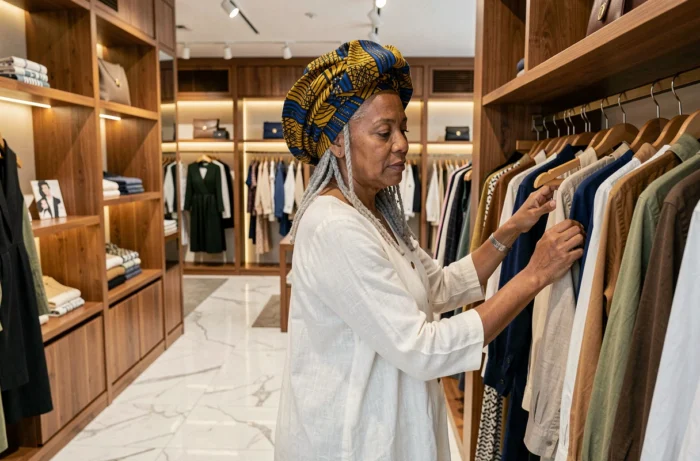
Curly or coily hair naturally creates volume under the fabric, resulting in a more imposing turban. This is an asset for afro styles, provided that a sufficiently wide fabric is chosen to envelop the hair without compressing the curls.
Coordinating a turban with an outfit: associations that work
The turban can enhance a look or throw it off balance. A few principles can help avoid missteps without stifling creativity.
A turban with a strong print (flowers, geometric patterns, bright colors) works best with a sober and monochrome outfit. The turban then becomes the centerpiece of the style, avoiding visual overload.
Conversely, a solid-colored turban in a neutral shade (black, camel, navy blue) integrates into a look already rich in patterns or accessories. It structures the hairstyle without competing with the rest of the outfit.
- With a flowing dress or a blouse with a wide neckline, the turban draws attention to the face and head posture.
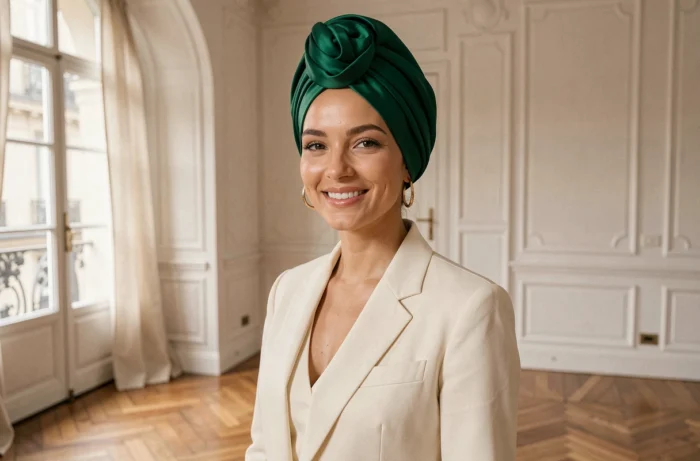
- With a structured coat or blazer, a silk turban adds a formal touch without overwhelming.
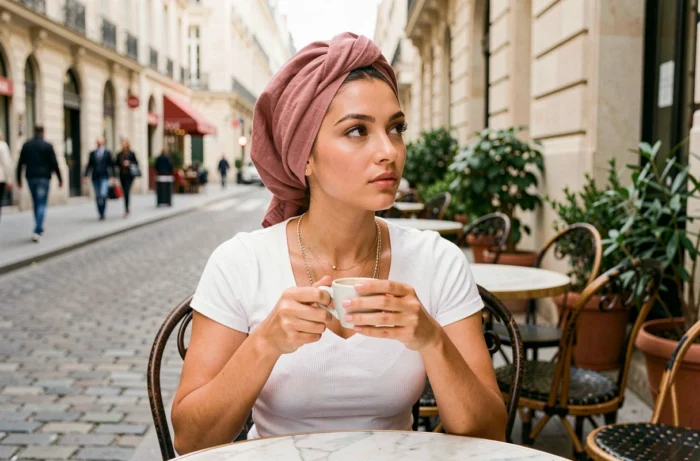
- With jeans and a basic t-shirt, a colorful turban is enough to transform a simple outfit into a bold look.
- For formal occasions, pairing the turban with dangling earrings creates a cohesive ensemble that highlights the oval of the face.
Turban and current fashion trends
Current hair trends emphasize voluminous hair accessories. The turban fits into this dynamic, worn in both sophisticated draped versions and casual tied at the back. Leopard prints, fine stripes, and terracotta shades are among the most popular choices.
The turban also serves as a winter hat alternative, with the advantage of not flattening the hairstyle. Models in merino wool or thick knit protect against the cold while maintaining a polished appearance.
This accessory remains one of the few hair elements that transcends seasons without losing relevance. Its longevity in wardrobes is due to its versatility: the same turban, tied differently, produces radically distinct effects depending on the material, volume, and context.