
The making of homemade natural candles relies on a limited number of ingredients, but the technical choices made beforehand influence the result as much as the process itself. Vegetable or animal wax, type of wick, fragrance concentration: each variable alters the combustion, scent, and lifespan of the finished product. The topic goes beyond mere creative leisure as soon as one considers indoor air quality or, for those contemplating selling, the recently tightened European regulatory obligations.
Indoor air quality and natural candles: what combustion reveals
Most tutorials present vegetable waxes as a healthy alternative to paraffin. The reality is more nuanced. Any combustion, even that of soy or beeswax, releases volatile organic compounds and fine particles into the ambient air.
The difference lies in the nature and quantity of these emissions. Vegetable waxes (soy, rapeseed) burn at a lower temperature than paraffin, which tends to reduce soot production. Beeswax, often noted for its natural honey scent, burns slowly and generates little black residue.
No candle, even labeled “natural,” is completely neutral for indoor air. Ventilating the room after use remains the most effective precaution, regardless of the type of wax chosen. Field reports vary on the actual extent of the difference between vegetable waxes and paraffin under common domestic conditions.
To delve deeper into the methods for making homemade natural candles, selecting the wax is the first structuring decision.
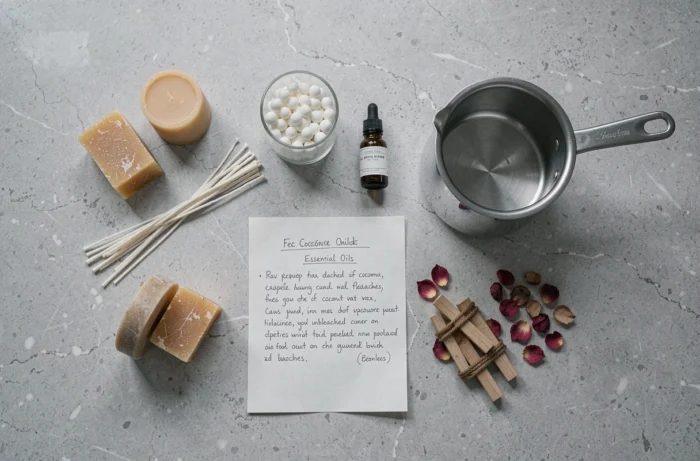
Soy, rapeseed, or beeswax: deciding based on use
Not all waxes are equal, and the choice depends on the type of candle intended (poured in a container, molded, pillar) as much as the desired scent profile.
Soy wax
This is the most common for homemade production. It melts at low temperatures, holds fragrances well, and offers a smooth surface after cooling. However, soy wax cannot stand alone as a pillar candle: it is too soft and requires a container.
Rapeseed wax
Produced in Europe, it reduces the logistical footprint compared to soy, which is often imported. Its texture is comparable, with a slightly different melting point. It blends well with soy wax to adjust hardness.
Beeswax
More expensive, it naturally emits a honey scent that can interfere with added fragrances. Beeswax is suitable for unscented or lightly scented candles. It can sometimes crack upon cooling, a flaw that can be minimized by adding a small amount of vegetable oil (coconut, apricot).
- Scented jar candle: prefer soy wax or a soy-rapeseed blend, which retains fragrances better
- Decorative molded candle: pure beeswax or a blend with a percentage of soy wax to limit cracks
- Self-supporting pillar candle: requires a hard wax, beeswax, or specific blends with plant additives
Wicks and combustion: the most underestimated parameter
The choice of wick determines the quality of combustion at least as much as the wax. A wick that is too thin creates a tunnel (the wax melts only around the flame), while a wick that is too thick produces a tall flame, soot, and too rapid consumption.
The diameter of the container dictates the size of the wick. Wick manufacturers provide matching charts, but these indications serve as a starting point. Only real combustion tests, by burning the candle in sessions of several hours, can validate the choice.
Braided cotton wicks remain the standard. Wooden wicks, popular for their crackling sound, require more frequent maintenance (trimming the charred wood between uses) and are not suitable for all waxes. A poorly calibrated wooden wick will extinguish itself in too fluid soy wax.

Fragrance allergens and European regulation: what changes in 2026
DIY tutorials rarely address the regulatory framework, as it does not directly concern personal use. The situation changes once one considers selling their creations, even on a small scale.
Regulation (EU) 2023/1545 has significantly expanded the list of fragrance allergens that must be declared individually on the label. The list increases from about 26 substances to over 80, with mandatory compliance for new products starting in summer 2026 and a transition period ending in 2028.
This directly affects the essential oils commonly used in natural candles. Limonene (citrus), linalool (lavender), and geraniol (rose, geranium) are among the allergens to declare. A creator of scented candles with essential oils must therefore know the exact chemical composition of each oil used to establish compliant labeling.
- Limonene: present in essential oils of orange, lemon, grapefruit
- Linalool: present in lavender, rosewood, bergamot
- Geraniol: present in geranium, lemongrass, rose
- Eugenol: present in clove, cinnamon
For strictly personal use, these obligations do not apply. However, selling scented candles without allergen declaration exposes one to penalties as soon as the regulatory threshold is crossed.
Fragrance concentration: finding the useful limit
The temptation is to add more essential oil or fragrance to achieve a more aromatic candle. Each wax has a maximum load rate beyond which the fragrance does not bind properly and seeps to the surface.
For soy wax, this threshold generally lies around a moderate proportion of the total wax weight. Exceeding this limit does not enhance the scent: it degrades combustion and can cause an unstable flame.
The flash point of each fragrance or essential oil deserves attention. It refers to the temperature at which the vapors of the fragrance can ignite. Adding fragrance to wax that is too hot destroys part of it through evaporation. Incorporating the fragrance just above the wax’s solidification point preserves the olfactory intensity.
The making of homemade natural candles becomes increasingly interesting as the European regulatory framework becomes clearer and consumers question the composition of the products they burn at home. Whether the goal remains creative pleasure or a budding commercial activity, the result depends less on the recipe itself than on the rigor applied to the choice of wax, the calibration of the wick, and the mastery of fragrances.