You recognize a Daft Punk track within the first few seconds, even before the title appears. This ability to identify an artist by their sound, without seeing their name, relies on precise sound construction work. Famous French DJs do not just mix: they create a unique musical imprint, a signature sound that distinguishes them in a saturated market of electronic productions.
Synthesizers, filtering, and production choices: the technical factory of a signature sound
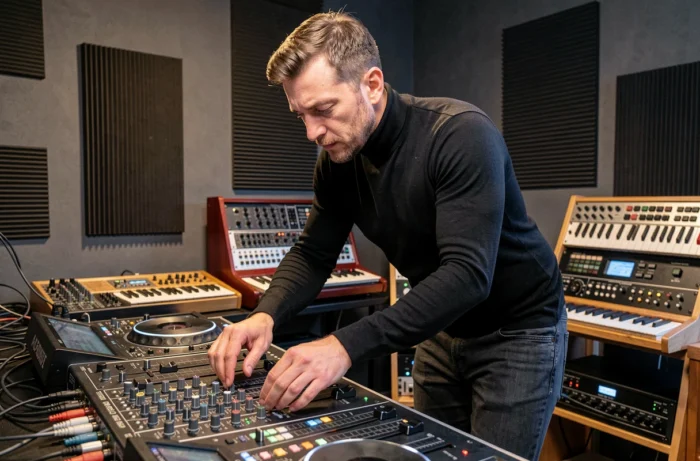
A signature sound does not arise from creative chance. It results from repeated technical decisions across dozens of tracks. The choice of a particular synthesizer, a filtering method, or a type of compression gradually shapes a recognizable sonic color.
Let’s take a simple example. A producer who systematically uses a low-pass filter on their synth pads creates a feeling of muffled warmth. If each track adopts this treatment, the listener associates this texture with that artist, even unconsciously. This is the principle of sonic recurrence as an identity marker.
The French Touch, a movement that emerged in France in the 1990s, illustrates this mechanism well. Artists like Daft Punk popularized the use of filtered disco samples and vocoders, creating a sound palette that the public eventually associated with French electronic music. As detailed in articles from Mon Blog Beauté on this subject, this approach goes beyond simple aesthetic preference: it constitutes a strategy for artistic differentiation.
David Guetta took a different path. His pop-house productions rely on accessible melodic structures, calibrated drops, and vocal collaborations that form a sound identifiable in just a few measures. The choice of sonic clarity over experimentation becomes, in itself, a signature.
Signature sound of French DJs and pressure of the music market
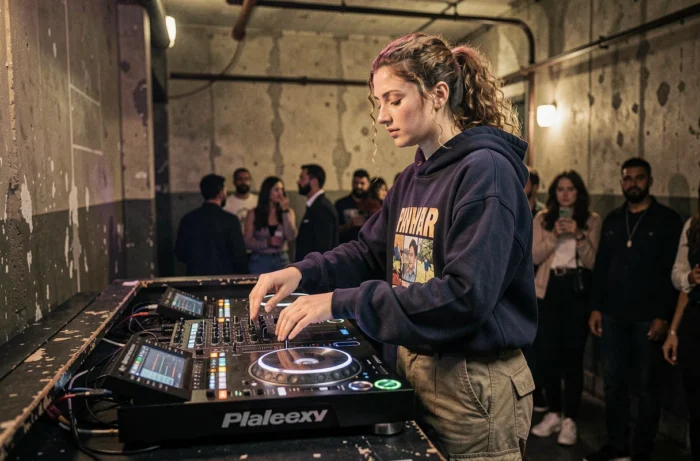
Why invest so much energy in a unique sound identity? Because the electronic music market operates on recognition. A DJ who sounds like everyone else disappears into the mass of weekly releases.
The paradox is documented by industry professionals. Label producers have noted that the demos received all end up sounding alike, as emerging artists imitate the catalog of the label they target. This phenomenon of categorization leading to homogenization pushes established artists to further deepen their uniqueness.
A famous French DJ with a signature sound enjoys several concrete advantages:
- His tracks are identified on the radio or in playlists without the title being played, which strengthens audience loyalty
- Festival organizers hire him for a precise sonic experience, not for an interchangeable set
- Collaborations with other artists gain value, as each featuring intersects two recognizable identities rather than two generic productions
The transition of the DJ from “the one who mixes” to “the one who performs an identifiable show” accentuates this logic. The visual dimension of current concerts (scenography, screens, effects) does not replace sound: it amplifies it. Without a distinctive sonic foundation, the show remains an empty shell.
Artificial intelligence and copyright: a new engine of differentiation
A recent factor reinforces the relevance of the signature sound. Since August 2, 2026, the European Union imposes transparency obligations for content generated or manipulated by artificial intelligence, with machine-readable marking and specific rules for general-use AI models.
You may wonder what this has to do with a French DJ? The link is direct. If an AI can generate tracks that imitate a musical style, the proof of human creation becomes a legal and commercial issue. An artist whose sound is documented by years of consistent productions has a strong argument against generative copies.
In France, the CSPLA (Higher Council for Literary and Artistic Property) published a mission report in July 2026 on the status of artificial intelligence productions. French copyright is tightening around documented human contribution in AI-assisted works. An artist who can demonstrate a personal creative process, recurring synthesis choices, and a traceable stylistic evolution protects themselves better than a producer whose style blends with algorithmic releases.
The lawsuit initiated by GEMA against Suno, an AI music generator, illustrates the ongoing legal tension. In this context, a signature sound is no longer just a marketing asset: it becomes a piece of evidence of artistic originality.

From remix to original single: how the signature sound evolves with the career
The signature sound is not fixed. It is built in stages, often through remixes before asserting itself on original singles.
A young producer often starts by remixing existing tracks. This format allows them to work on an already established structure while applying their personal touch. Remixes function as a training ground where the producer tests sound treatments, tempos, and arrangements.
When an artist moves to a single or album, their sonic identity is already partially constructed. Listeners who have followed their remixes find familiar elements in their original compositions. This continuity creates a thread that the audience follows from one release to the next.
- The remix allows for exploring a sound without starting from scratch, relying on existing material
- The original single consolidates recurring choices and transforms them into a trademark
- The album provides the necessary space to deploy the signature sound over a long duration, with variations that show its depth
French artists from electronic duos to solo house producers have followed this trajectory. The coherence between early productions and recent albums confirms that the signature sound is a long-term project, not an accident.
Building a unique sound remains the best investment a French DJ can make. In a landscape where AI generates tracks on demand and labels receive interchangeable demos, human and traceable sound identity is what separates an artist from a catalog.