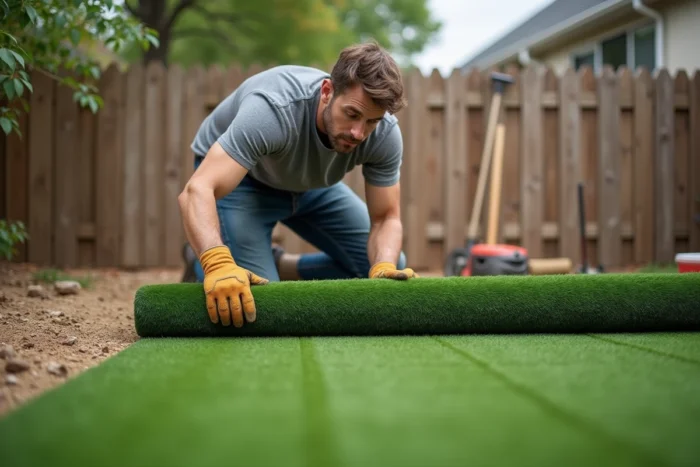
A poorly secured synthetic lawn can be identified within a few weeks: wrinkles that bulge, visible joints, edges that lift in the wind. The problem rarely comes from the product itself. It stems from the substrate and the method of fixation, two parameters that most guides treat superficially.
Choice of weighting and fixation according to the type of substrate
The fixation of a synthetic lawn is not limited to driving in stakes or gluing a strip. Each substrate requires a distinct fixation method, and mixing techniques generates issues in the medium term.
On soft ground (earth, stabilized sand), we recommend metal stakes around the perimeter every 20 to 30 cm, driven in at an angle to resist pulling out. A straight stake, placed vertically, works poorly in soil that shrinks in summer. A slightly outward-angled insertion increases mechanical hold without deforming the backing.
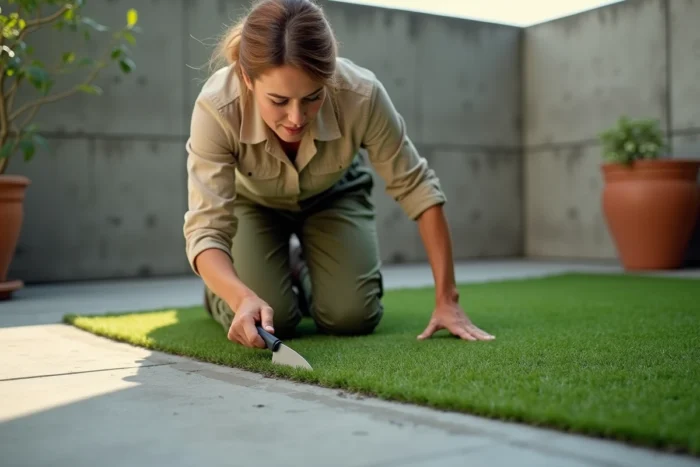
On concrete slabs or screed, fixation relies on two-component polyurethane glue applied in a continuous bead around the entire perimeter and at the joints. Double-sided tape, often presented as a quick alternative, does not withstand the thermal cycles of an exposed terrace. After one summer, the tape loses its adhesion and the edges peel away.
On balconies, the main constraint is weight. The synthetic lawn is generally not glued but weighted down by furniture and peripheral borders clipped or screwed into the railing. Insufficient weighting on windy balconies causes a sail effect that strains the fibers and shifts the covering.
To properly understand how to install and secure synthetic grass according to your configuration, the choice between stakes, PU glue, and mechanical weighting must be made before even unrolling the first strip.
Preparation of soft ground: compaction and flatness
Poorly compacted ground settles unevenly under the weight of the grass and any infill. The result: visible depressions, puddles of stagnant water, and premature aging of the backing due to hydrolysis.
Compaction with a roller or vibrating plate is the step that determines the durability of the entire installation. We observe on-site that most defects appearing in the first six months are related to insufficient or absent compaction.
Preparation sequence on natural soil
- Excavation by a few centimeters to remove the organic layer, including roots, followed by the application of a root herbicide or the installation of an anti-regrowth geotextile.
- Possible addition of a layer of limestone sand or fine all-in aggregate, spread with a rake, then compacted in two crossed passes with the vibrating plate.
- Verification of flatness with a mason’s rule: a deviation greater than a few millimeters per linear meter will be visible once the grass is laid, especially with short fibers.
- Installation of the geotextile with an overlap of at least 10 cm between the strips to block any plant growth at the joints.
Skipping the geotextile to save time is a false economy. Without this barrier, weeds penetrate the backing in one season, and repairing requires removing everything.
Joints between strips of synthetic grass: the critical area
The joint is the weak point of any multi-strip installation. If poorly executed, it remains permanently visible as a clear line or a misalignment of fibers.
All strips must be oriented in the same direction of fibers, indicated by the arrow printed on the back of the roll. A strip laid in the opposite direction creates a different color effect under low light, even if the product is identical.
Joint technique on soft ground
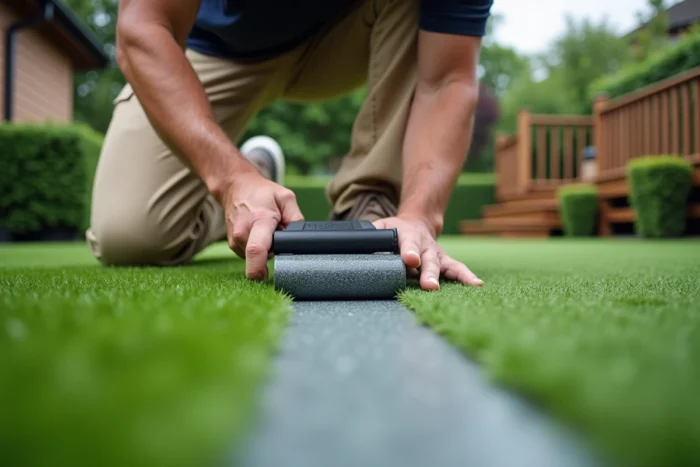
On earth or sand, the self-adhesive geotextile joint tape remains the standard. It is laid under both strips, adhesive side up. The edges of the grass are then folded over and pressed against the tape. A common mistake is pulling the strips too tightly to bring them closer, which compresses the fibers at the joint and creates a visible bulge.
We recommend leaving a gap of a few millimeters between the two strips, with fibers folded outward, then positioning them edge to edge without tension. Final brushing straightens the fibers and masks the joint line.
Joint on slab or concrete
On hard surfaces, PU glue replaces the adhesive tape. The glue bead is applied on the joint tape (non-woven fabric), the two strips are folded over it, and then weighted down with weights during the curing time. The complete curing of PU glue generally takes several hours, during which the grass should not be stressed.
Synthetic grass on exposed terrace: a retreat in use
Classic installation guides do not mention a phenomenon we have observed for several years: the retreat of synthetic grass on south-facing terraces. Several specialized media in outdoor landscaping note a trend towards replacing synthetic grass with mineral or composite slabs laid on a sand bed, which do not heat up in the sun and can be easily disassembled.
The technical problem is real. A dark-colored synthetic grass on a south-facing terrace can reach very high surface temperatures in summer, making barefoot walking uncomfortable or even impossible. The most exposed fibers also undergo accelerated UV aging, losing flexibility and color.
If your terrace is south-facing, evaluating the alternative of draining mineral coverings before committing to synthetic grass can prevent premature replacement. This is not a defect of the product itself, but an incompatibility between the substrate and the use.
Maintenance and brushing after installation: the action that extends lifespan
Brushing is not just a finishing aesthetic step. It conditions the longevity of the fibers over time. A lawn that is never brushed sees its fibers lay down permanently, especially in high-traffic areas.
A pass with a stiff-bristled brush (not metallic) once or twice a year, against the grain, is enough to straighten the fibers and dislodge organic debris stuck at the base. Electric brushes, long reserved for professionals, are becoming more accessible and facilitate maintenance on large areas.
Drainage also deserves an annual check. On soft ground, a properly laid lawn on geotextile drains naturally. On slabs, check that the drainage holes in the backing are not blocked by limestone or organic deposits; otherwise, water will stagnate and promote mold under the covering.