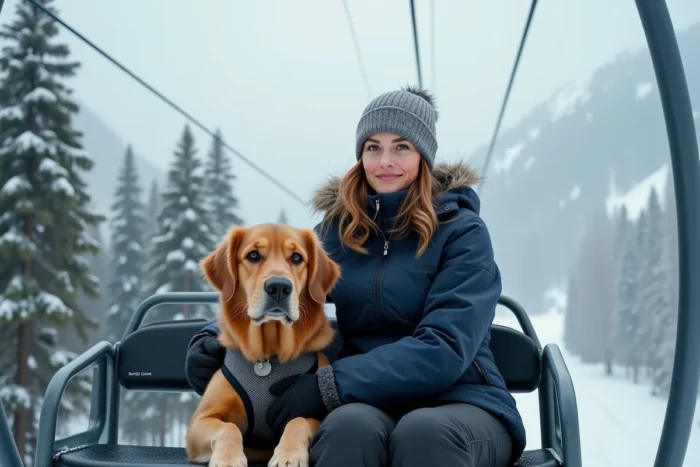
Most ski lifts in France were not designed to transport animals. Taking a chairlift with a dog requires checking specific conditions that vary by device and station. The rules differ depending on the type of lift (detachable chairlift, cable car, gondola), the season, and sometimes the time of day.
Regulations for ski lifts and dogs: what is decided at the local level
No national law establishes a uniform framework for dogs’ access to chairlifts. Each lift operator defines its own access conditions, based on the station’s internal regulations and applicable municipal orders.
Some stations allow dogs outside of peak times, while others prohibit any animals on the lifts. The distinction is often made lift by lift, not just station by station. The page for the Prodains cable car in Avoriaz, for example, details specific hours for pedestrians with distinct summer/winter rates, indicating that access conditions must be checked for each device individually.
Stations that accept dogs generally require a muzzle and a short leash. Before planning an outing, a direct call to the lift service remains the most reliable way to know the rules for the day. The possibility of sharing a chairlift with your dog depends on this prior verification, and regulations may change without notice from one season to the next.
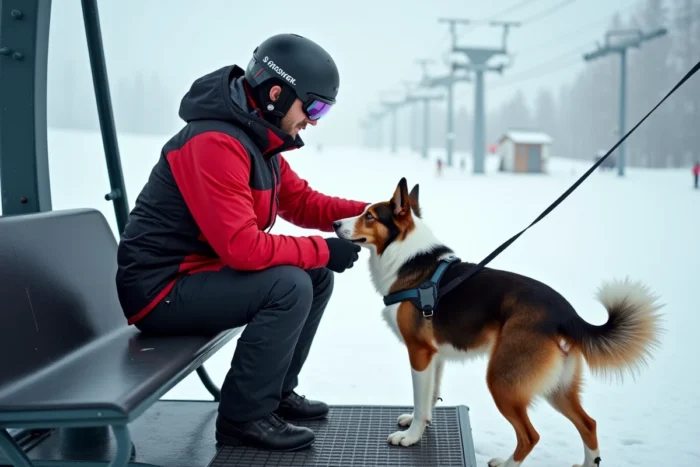
Dog behavior on a chairlift: signals to assess before boarding
A chairlift produces unusual stimuli for a dog: continuous mechanical noise, the ground moving away, gradual height, lateral wind. The dog’s reaction to the void and noise determines the feasibility of the journey, much more than its size or breed.
A pet that panics at the time of boarding creates a risk for itself and for the other passengers. The assessment should be done in advance, not at the foot of the lift.
Preparing the dog for mechanical stimuli
A dog that has never been exposed to a noisy and mobile environment may develop a flight or freeze response. Preparation involves gradual exposure to loud noises, moving platforms (escalator, metal walkway), and situations where the ground changes beneath its paws.
- Test the dog’s reaction on a metal walkway or suspension bridge before considering the chairlift
- Get it used to staying still in a sitting or lying position for several minutes, even in the presence of sound stimuli
- Observe its behavior at heights (balcony, viewpoint) to spot any signs of stress (excessive panting, trembling, attempts to escape)
A dog that remains calm in these situations will be more likely to endure the journey. A dog showing signs of distress should not be forced to board.
Equipment and positioning during the chairlift ride
The equipment used directly affects the safety of the dog and other passengers. A harness is preferable to a collar to avoid any risk of strangulation in case of sudden movement.
Short leash and attachment point
The leash should be short enough to prevent the dog from jumping or slipping out of the seat, but not so tight that it forces the dog into an uncomfortable position. A length of about an arm’s length between the harness and the owner’s hand is a good guideline.
The dog should be positioned between the owner’s legs or on their lap, depending on its size. The animal should never be placed on the armrest or left without physical contact with its companion. Reassuring contact (hand on the chest, calm voice) reduces stress during the lift’s takeoff and landing phases.
Muzzle: a common requirement and choice of model
The majority of stations that allow dogs require the use of a muzzle. A basket-type muzzle (like Baskerville) allows the dog to pant and drink, unlike fabric muzzles that block thermoregulation. At altitude, where heat can be surprising in summer, a muzzle that allows the dog to breathe freely is a safety choice, not a comfort one.
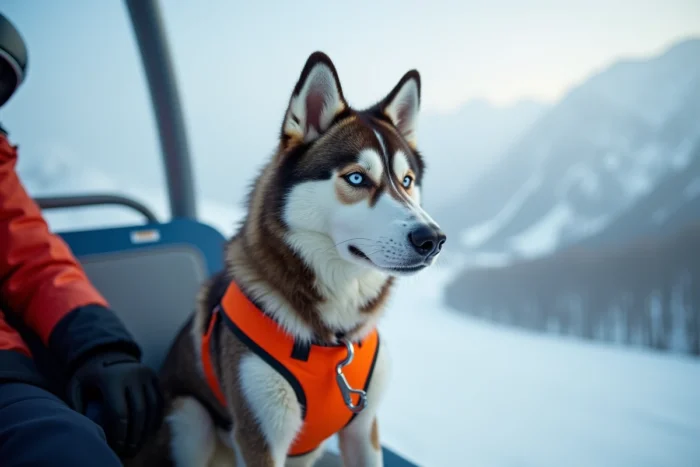
Guide dogs and access to lifts: an often-overlooked angle
The issue of dogs on ski lifts is not limited to leisure. Guide dogs for the blind and assistance dogs benefit from a distinct legal framework. Their access to public transport and establishments open to the public is guaranteed by law, but the application to a private ski lift remains a gray area in practice.
Recent content on mountain accessibility explicitly mentions the case of a cable car with a guide dog. This issue should be directly addressed to the operator, as the refusal of a guide dog may constitute discrimination under disability legislation, even if safety conditions justify adjustments.
Chairlift, gondola, or cable car: the differences for the dog
Not all types of lifts present the same level of difficulty for an animal.
- The chairlift exposes the dog to open air, wind, and heights. The risk of falling exists if the animal is not properly secured
- The gondola, being enclosed, offers a more reassuring closed space for the animal, but the noise of closing doors and swaying can trigger stress
- The cable car, with its large capacity and wider movements, may impress dogs sensitive to vibrations
The chairlift remains the most demanding type of lift for the animal, as it combines exposure to heights, rapid boarding, and the absence of protective walls. The presence of other passengers on the same seat adds a variable: not all users are comfortable with a dog nearby, and respecting their space is part of the conditions for acceptable cohabitation.
Every outing in the mountains with a dog on a lift requires a balance between the pleasure of sharing the experience and the animal’s actual ability to handle it. A dog that hikes perfectly in the mountains may struggle with a chairlift ride. The most responsible decision is made on a case-by-case basis, device by device, and sometimes day by day.