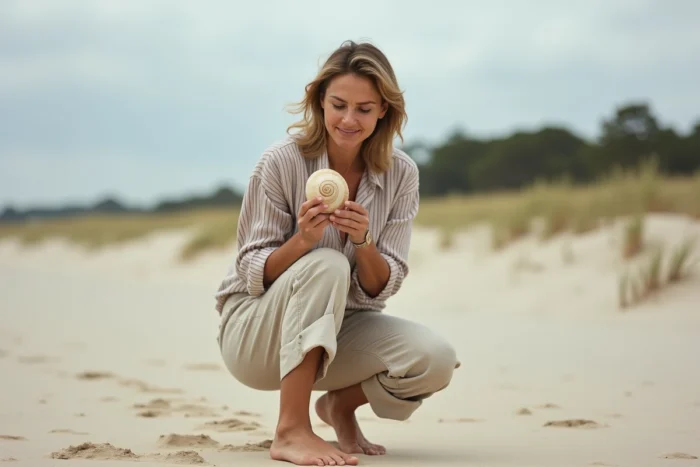
The Landes coast, dominated by a nearly continuous sandy shoreline for over a hundred kilometers, does not have the same profile as the rocky shores of Brittany or the mudflats of Charente. The absence of a hard substrate limits the diversity of attached species, but the sandbanks exposed at low tide concentrate burrowing bivalves in sometimes remarkable densities. Collecting shellfish in the Landes requires targeting the right beach segments and understanding the local sediment dynamics.
Health Classification of Intertidal Fishing Areas in the Landes
Before thinking about spots, we recommend checking the health classification of the desired area. Prefectures and Ifremer regularly publish temporary closure orders related to the presence of toxins (phycotoxins such as ASP or DSP) or episodes of bacterial contamination after heavy rains. These closures can affect a specific area for several weeks, without visible signage on the beach.
In Nouvelle-Aquitaine, controls on intertidal fishing have significantly tightened since 2024. Fines can reach 1,500 euros per bucket for exceeding quotas or failing to respect minimum sizes. Maritime affairs agents operate both in the Arcachon basin and on the Landes beaches of Biscarrosse, Mimizan, or Contis.
We observe that most popular articles overlook this point, merely listing beaches without mentioning that harvesting may be prohibited on certain days. Consulting the ARS Nouvelle-Aquitaine website or the prefectural notices the day before each outing remains the basic reflex.
Spots on the Southern Landes Coast: Capbreton, Hossegor, and the Huchet Current
The Capbreton-Hossegor area benefits from a rare geomorphological feature on this coast: the Capbreton canyon, an underwater canyon that rises very close to the shore, generates upwelling currents bringing fine sediment and shells. After winter storms, the wrack line here is often richer than elsewhere in empty shells (scallops, tellins, knives).
For harvesting live bivalves, it is the estuary area of the Huchet current, further north towards Moliets, that offers a muddy foreshore conducive to clams and cockles when it is open to fishing.
You can discover La Top Liste of the referenced sites in this area to cross-check field feedback with regulatory data before you go.
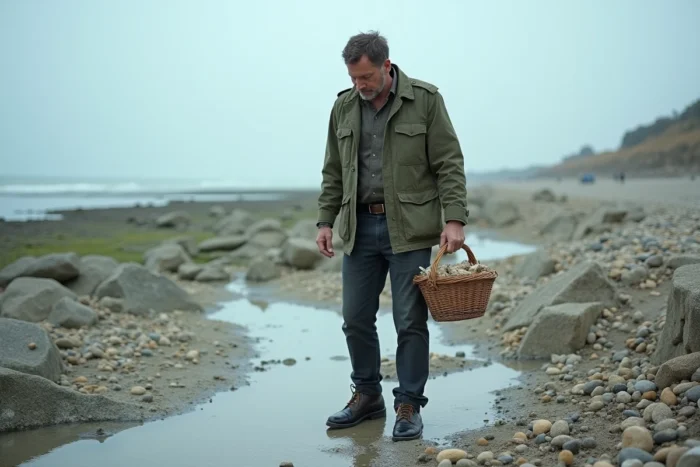
In Hossegor, the marine lake connected to the ocean constitutes a brackish environment where wild oysters attach to the rockwork of the canal. Their harvest remains subject to the same size and health classification rules as everywhere else in Nouvelle-Aquitaine.
Mimizan and Biscarrosse Beaches: Reading the Sand to Find Deposits
On the long straight beaches between Biscarrosse and Mimizan, live shellfish concentrate in the pools, these depressions parallel to the shore that retain water at low tide. Spotting a pool is done visually: a calm, shallow area bordered by a raised sandbank. This is where cockles and donaces (tellins) bury themselves a few centimeters below the surface.
The most effective technique on this type of substrate remains scraping with a tellin rake, a small rake with short teeth pushed backward into the wet sand. Knives (Ensis) reveal themselves by a keyhole-shaped hole on the surface of the sand. A pinch of salt placed in the hole causes the shellfish to rise, a selective method that avoids disturbing the foreshore.
- Cockles (Cerastoderma edule): minimum capture size of 3 cm, harvested in pools and muddy sand areas at the foot of the dune.
- Tellins (Donax trunculus): small flat bivalves buried in the first centimeters of fine sand, abundant after spring tides.
- Knives (Ensis spp.): present on gently sloping exposed beaches, identifiable by their characteristic holes at low tide.
Biscarrosse-Plage, south towards the Sainte-Eulalie current, offers a less frequented area where cockle deposits remain exploitable outside of the high season. Summer attendance disrupts the foreshore and disperses the colonies, making spring or autumn outings more productive.
Tide Coefficients and Collection Windows on the Landes Coast
The Landes coast experiences moderate tidal ranges compared to northern Brittany, but spring tides (coefficients above 90) still expose areas that are usually submerged. These time slots are the only ones where certain deposits become accessible on foot.
We recommend planning outings around low tide during spring tides, which occurs twice a month during the new and full moon. Arriving an hour before low tide allows time to prospect without being caught off guard by the rising tide. On open Landes beaches, the sea rises quickly on a gently sloping foreshore: tight timing is non-negotiable.
Specific Regulations to Remember
- Recreational intertidal fishing is limited to a quantity per person per day, generally a few kilograms depending on the species, set by prefectural order.
- The use of mechanized equipment or wide shovels is prohibited on the foreshore for recreational fishing.
- Live shellfish harvested must be consumed quickly; resale is prohibited without a professional license.
- Supervised swimming areas are often incompatible with intertidal fishing during summer surveillance hours.
The Landes coastline remains an underestimated intertidal fishing ground compared to the Charente or Breton spots. Its specificity lies in the exclusively sandy nature of the foreshore, which concentrates effort on burrowing bivalves and requires careful reading of the beach relief. Temporary health closures and the tightening of controls since 2024 necessitate advance preparation that mere desire to collect a few cockles can no longer bypass.