
The property tax represents a recurring charge for every owner, but the general tax code provides specific provisions for people with disabilities. Holders of the mobility inclusion card mentioning disability, beneficiaries of the AAH or the additional disability allowance: the conditions for exemption vary depending on administrative status, household income, and housing occupancy. The framework applicable in 2024 is based on precise criteria, not always well understood by the taxpayers concerned.
Automatic exemption from property tax: the CAF-DGFIP data crossover
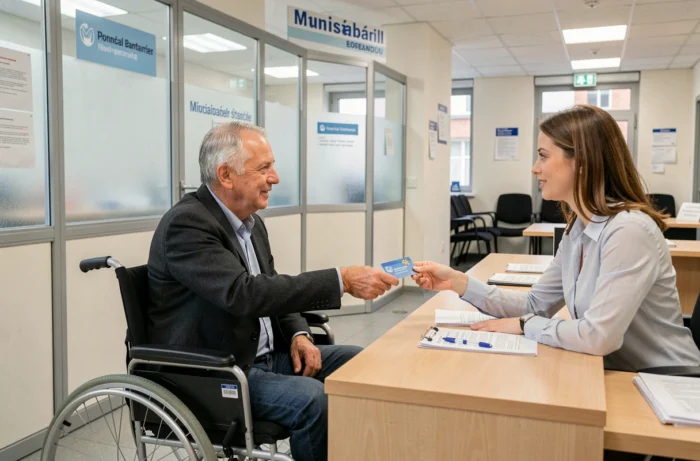
A point rarely detailed in public tax guides concerns the very mechanism of the exemption. For beneficiaries of the AAH, ASPA, or ASI, the exemption is automatically applied by the tax administration. The taxpayer does not have to fill out a form or provide supporting documents to the tax office.
This automatic nature relies on a data exchange between social organizations (CAF, MSA) and the General Directorate of Public Finances. Specifically, if you receive the AAH and your reference tax income remains below the legal thresholds, your property tax notice directly includes the exemption.
This does not mean that errors are impossible. Taxpayers regularly report receiving a full-rate property tax notice despite their eligibility. In this case, a claim to the personal tax service allows the situation to be regularized, but sometimes it is necessary to provide proof of AAH payment. The details of property tax exemptions with a disability card should be checked each year, as income thresholds change.
Reference tax income thresholds: the limits to know
The total exemption from property tax on the primary residence is not solely linked to disability status. It is conditioned by compliance with a reference tax income (RFR) ceiling, which varies according to the composition of the household.
For notices issued in 2024 (2023 income), the thresholds published by the administration are as follows:
- For a single person (1 share): the RFR must not exceed the threshold set by article 1417 of the CGI, updated each year.
- For a married or civil partnership couple without dependents (2 shares): the ceiling rises to 19,107 euros according to data published by impots.gouv.fr for 2024.
- Each additional half-share (dependent child, disability) raises this ceiling by an amount set by the finance law.
These thresholds are re-evaluated each year. For 2026, the administration confirmed updated ceilings: 12,793 euros for 1 share and 19,625 euros for 2 shares in mainland France. The frequent confusion concerns the reference year: it is the RFR from the tax notice of the previous year that serves as a basis, not the income of the current year.
Mobility inclusion card, AAH, ASI: which statuses entitle one to property tax exemption
Not all disability titles provide access to the same tax benefits regarding property tax. The distinction is clear between the provisions related to income tax (additional half-share, deductions) and those specifically concerning property tax.
Total property tax exemption
Those who can benefit from a complete exemption on their primary residence, subject to income conditions:
- Holders of the adult disability allowance (AAH), regardless of their age.
- Beneficiaries of the additional disability allowance (ASI).
- Holders of the solidarity allowance for the elderly (ASPA).
The mobility inclusion card mentioning disability alone is not sufficient to obtain the property tax exemption. It entitles one to the additional half-share for income tax calculation, which is a distinct advantage. Confusion between these two mechanisms is common.
Housing occupancy condition
The exemption applies exclusively to the primary residence. The housing must be occupied by the taxpayer, alone or with their spouse, or with dependents, or with individuals whose RFR also meets the ceilings.
A point often overlooked: individuals who leave their home to enter a nursing home or assisted living retain the exemption on their former home as long as it is not rented. This provision protects disabled or elderly owners who can no longer occupy their property but do not wish to part with it.
100 euro tax relief and property tax: an intermediate provision
Taxpayers who do not meet the conditions for total exemption can benefit from partial relief. A flat-rate relief of 100 euros applies to the property tax of the primary residence for individuals aged 65 to 75 as of January 1 of the tax year, under the same RFR ceiling condition.
This relief does not directly concern holders of the disability card under 65 who do not receive either the AAH or the ASI. For these taxpayers, the reliefs are limited to benefits on income tax (half-share, special deduction for disabled individuals attached to the tax household).
However, a beneficiary of the AAH aged under 65 can be totally exempt if their RFR meets the ceilings, which goes beyond the simple 100 euro relief. The status of AAH beneficiary takes precedence over the age condition for total exemption.
Checking your property tax notice: errors to spot
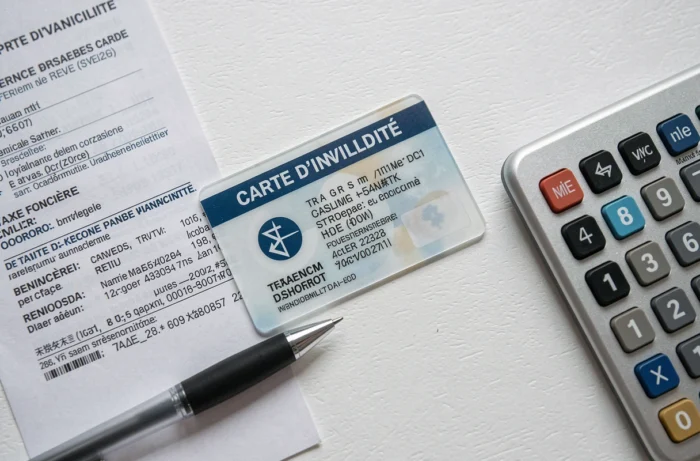
The automation of the system does not guarantee the absence of anomalies. Several situations cause recurring errors on property tax notices for disabled individuals.
A change in family situation (divorce, death of a spouse) can alter the number of shares and push the RFR above the ceiling without the taxpayer being aware. Similarly, a delay in the transmission of data between the CAF and the DGFIP can lead to the issuance of a full-rate notice for a taxpayer who is eligible.
The claim is made to the personal tax service, by mail or via the secure messaging on impots.gouv.fr. The claim period runs until December 31 of the year following the collection. After this period, the exemption is lost for the year concerned, even if the taxpayer met the conditions.
The tax regime related to disability remains fragmented among several provisions (property tax exemption, half-share IR, deductions, tax credits for housing adaptations). Each mechanism responds to its own eligibility criteria, and none automatically derives from the mere possession of a disability card. Checking your notice and rights each year remains the most effective precaution.