
Classic tech news sites align product sheets and smartphone tests. Then there are the sections that take the opposite approach: commenting on technology through the lens of the absurd, the satirical, and the downright bizarre. This niche attracts a growing readership, especially because artificial intelligence, deepfakes, and improbable gadgets provide an inexhaustible raw material.
Satirical deepfakes and regulatory framework: when tech jokes pose a legal problem
Have you ever seen a video of a political figure generated by AI, presented as a parody? This type of content has exploded in recent years. The problem is that the line between satire and misinformation remains blurry for many internet users.
Between 2023 and 2025, several regulatory frameworks have strengthened around potentially misleading generated content. Investigations and warnings from platforms have targeted manipulated videos or images used in a pseudo-satirical context but without a clear mention of their fictional nature. This tightening also affects blogs and humorous sections that use generative AI to produce visuals or synthetic voices.
A quirky tech section that publishes a deepfake of a minister without a readable warning is now exposed to reports. This is precisely the type of subject found in the tech section of Sarkostique, which addresses technological news with a caustic eye while documenting these gray areas.
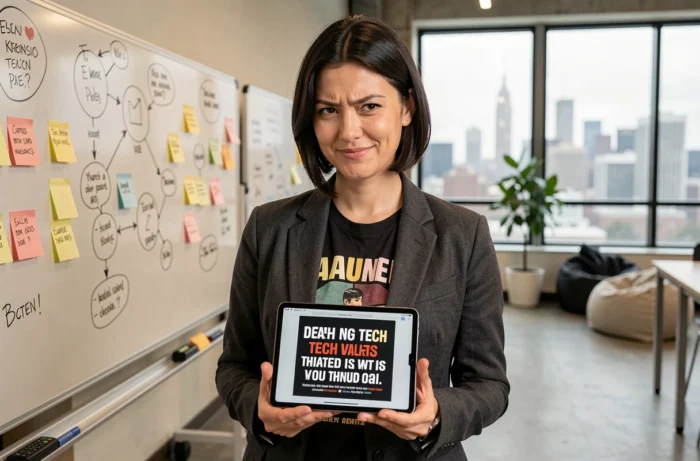
Artificial intelligence and recruitment: ChatGPT-boosted resumes, a new satirical material
A candidate sends a resume entirely written by ChatGPT. The recruiter uses another AI tool to sort it. No one reads anything, everyone is satisfied. This barely caricatural scenario fuels a well-documented humorous vein in the tech press.
Fake resumes generated by AI are being detected in increasing numbers in recruitment processes. Blogs by labor law experts and higher education journals have published analyses on the phenomenon. Students have been sanctioned for entirely generated theses. Marketing campaigns deemed “too perfect” have led to public rejection.
What makes these stories suitable for an unusual section is their absurd dimension. The technology meant to facilitate a process ends up stripping it of its meaning. Satirical sections seize on this because the gap between the promise (saving time) and the result (no one really communicates anymore) produces an immediate comedic effect.
Three typical cases that fuel tech humor
- The customer service chatbot that loops indefinitely on the same response, documented by viral screenshots on social media, then taken up in a satirical format by specialized blogs
- AI-generated images with six-fingered hands or incoherent text, which have become a visual genre in their own right, shared as an involuntary marker of artificial content
- Voice assistants that trigger unwanted commands (online purchases, accidental calls), turned into running gags in quirky tech newsletters
Cybersecurity and the absurd: vulnerabilities that make you laugh (before scaring you)
Cybersecurity regularly produces stories worthy of a sketch. An administrator password left as default on critical infrastructure. A confidential source code accidentally published on a public repository. The most serious security flaws are often the most mundane.
This register works well in satirical tech sections because it highlights a paradox. We invest in sophisticated protection systems, but the vulnerability comes from a basic human oversight. The contrast between technical complexity and the simplicity of the error creates a solid comedic spring.
Humor blogs focused on cybersecurity (like those referenced on specialized English-speaking platforms) exploit this vein by compiling verifiable anecdotes. The format works: a short story, a simplified technical context, a punchline that underscores the absurdity.

Satirical tech blogs in France: an editorial format in development
The French landscape of humorous tech media remains more limited than its English-speaking counterpart. Most “quirky” sections in the French scientific and technical press are limited to relaying wacky discoveries or crazy inventions, without a real constructed satirical editorial line.
The satirical tone applied to technological news requires double the work: understanding the technical subject, then finding the angle that reveals its absurdity. It’s more demanding than a simple compilation of amusing briefs.
Several characteristics distinguish the sections that endure:
- A regular publication rhythm, even modest, that builds a niche readership rather than a viral traffic spike with no follow-up
- A grounding in verifiable news (a real fact, an identifiable source) rather than pure fiction, which lends credibility to the satirical argument
- An ability to address substantive issues (AI regulation, digital policy, surveillance) without losing the quirky register
The difficulty also lies in SEO. Search engines do not spontaneously distinguish a satirical article from a factual one. Well-sourced humorous content ranks better than a parody without context. Sections that understand this structure their articles with real technical keywords (artificial intelligence, security, new technologies) while maintaining their tone.
The satirical register applied to tech does not replace investigative journalism or product testing. It occupies another role: making visible, through humor, what traditional coverage treats with a seriousness that sometimes masks the absurdity of the situation. A minister’s deepfake presented as a joke, a resume entirely generated by AI, a password “admin” on critical server: these stories deserve to be told, and the satirical format gives them an audience that a technical report would not achieve.