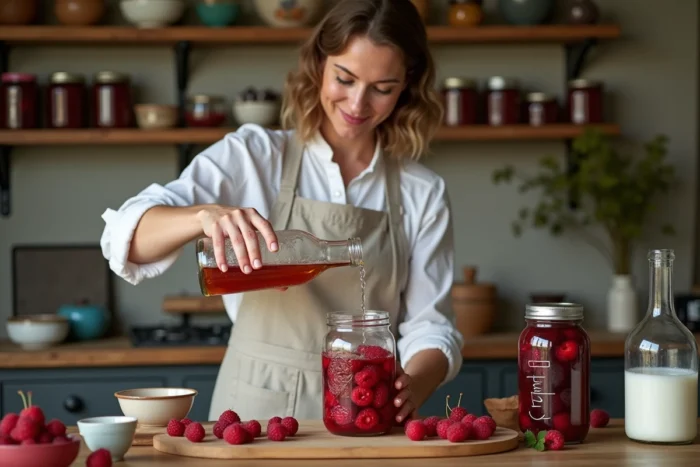
Neutral alcohol at 90° for fruits, once commonly found in supermarkets, is becoming scarce on the shelves of several French retailers. The product has not disappeared from the market, but its distribution has become fragmented. For enthusiasts of homemade liqueurs, fruit in brandy, or limoncello, the question of a substitute arises with a specific technical constraint: the alcohol content of the base directly affects the extraction of flavors, preservation, and final taste.
Alcohol content and extraction: what the chosen base really changes
A neutral alcohol with an alcohol content around 90° acts as a powerful solvent for the aromatic compounds of fruits. The higher the degree, the faster and more complete the extraction of essential oils, pigments, and natural sugars. Dropping to 40° (vodka, white rum) slows this process and produces a different result, not necessarily inferior.
The distinction lies in the desired final profile. A maceration in strong alcohol yields a dense aromatic concentrate, which is then diluted with sugar syrup. A maceration in vodka or fruit brandy produces a softer result, ready to consume without significant dilution. The degree of alcohol determines the method, not the quality of the finished product.
Some French artisanal distilleries offer neutral alcohol at 96°, intended to be diluted to between 70° and 75° before maceration. This option remains the closest to the old supermarket fruit alcohol, with identical usage: one adjusts the degree oneself by adding distilled or filtered water before incorporating the fruits.
At this stage, it is useful to understand which neutral alcohol for fruits Leclerc was actually used and why its partial disappearance necessitates rethinking the dosages.
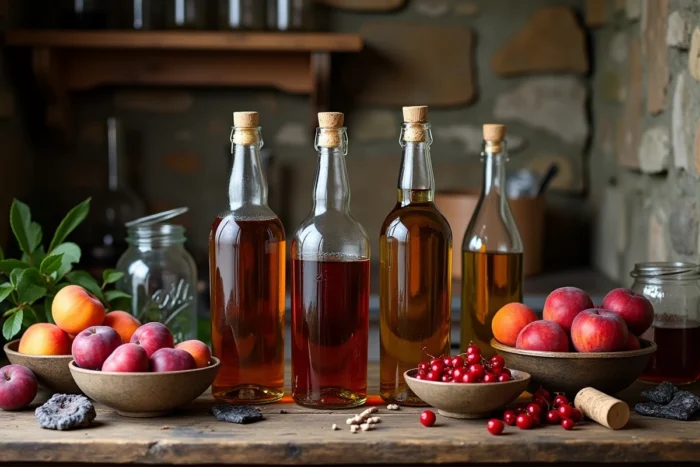
Vodka or fruit brandy for homemade fruits: two different logics
Vodka is the most accessible solution. It generally has an alcohol content around 40°, is found in all stores, and its aromatic neutrality makes it versatile. For a cherry liqueur or limoncello, it works well, provided you accept two adaptations.
- The maceration time increases: expect a minimum of three to four weeks to achieve a proper extraction of flavors, compared to one to two weeks with 90° alcohol.
- The shelf life is shorter: a lower final degree promotes oxidation. Preparations based on vodka can be kept for several months in the refrigerator, but do not age as well as a liqueur based on strong alcohol.
- The volume of added sugar must be reduced proportionally, as alcohol dilutes syrup less. The risk is to obtain a liqueur that is too sweet if following a recipe calibrated for 90° alcohol.
Fruit brandy (pear, plum, mirabelle) follows an opposite logic. It often has an alcohol content between 40° and 45°, but brings its own aromatic signature. Using mirabelle brandy to macerate mirabelles enhances the fruity character, whereas vodka fades behind the ingredient.
White rum, often cited as an alternative, has an alcohol content between 40° and 55° depending on the references. Agricultural rums at 55° offer an interesting compromise in terms of degree, but their aromatic profile (sugar cane, vegetal) imposes itself in the result. It is not a neutral alcohol: it is a deliberate flavor choice.
Neutral alcohol online: check the food mention before purchase
The sale of high-proof neutral alcohol has shifted to specialized sites and some distilleries selling directly. References at 96° are available in one-liter bottles, shipped by carrier. The price per liter is significantly higher than that of the old supermarket fruit alcohol.
Every bottle purchased must bear the mention “food alcohol” or “for food use”. Denatured alcohols, sold in pharmacies or drugstores, contain additives (camphor, methanol, bitrex) that render them unfit for consumption and potentially toxic. The label must also indicate “ethyl alcohol of agricultural origin” to ensure a base derived from the distillation of plant materials (beet, grape, cereal).
Field reports vary on the quality of neutral alcohols sold online. Some buyers report residual tastes on products that are labeled “neutral”. A quality neutral alcohol should have no perceptible odor once diluted to 40°. If an odor persists, the product has likely been insufficiently rectified during distillation.
Home distillation banned in France: the legal framework to know
Content on homemade liqueurs rarely mentions a crucial constraint. Home distillation of spirits remains prohibited in France. Making neutral alcohol from fermented fruits, grains, or beets is not legal without the status of a distiller or specific authorization.
The only practice allowed for individuals is infusion or maceration in already marketed alcohol. This is what concretely directs one towards purchasing industrial or artisanal neutral alcohol, and then using it as a maceration base.
This ban also explains why the market for high-proof food neutral alcohol remains a niche segment. Demand exists, but distribution channels remain limited compared to those for classic spirits.
Adapting liqueur recipes to the actual degree of alcohol used
Switching from 90° alcohol to 40° vodka does not equate to changing one ingredient for another. The entire recipe must be recalibrated. The fruit/alcohol ratio increases, as extraction is less effective. The sugar syrup must be adjusted downward to avoid an imbalance.
- On a base at 90° diluted to 70°, the classic proportion is about one volume of fruit for one volume of alcohol, with syrup added after filtration.
- On a vodka base at 40°, increasing the amount of fruit by about a third helps compensate for the loss of extraction.
- The maceration time extends from a few weeks to a month or more, depending on the density of the fruit (citrus fruits release their oils faster than cherries or plums).
Filtration remains the same regardless of the degree: a pass through a coffee filter or a fine cheesecloth is sufficient to eliminate suspended particles. The final result depends more on the quality of the fruits than on the degree of alcohol. Ripe, healthy, and in-season fruits will produce a more aromatic liqueur than strong alcohol combined with mediocre fruits.